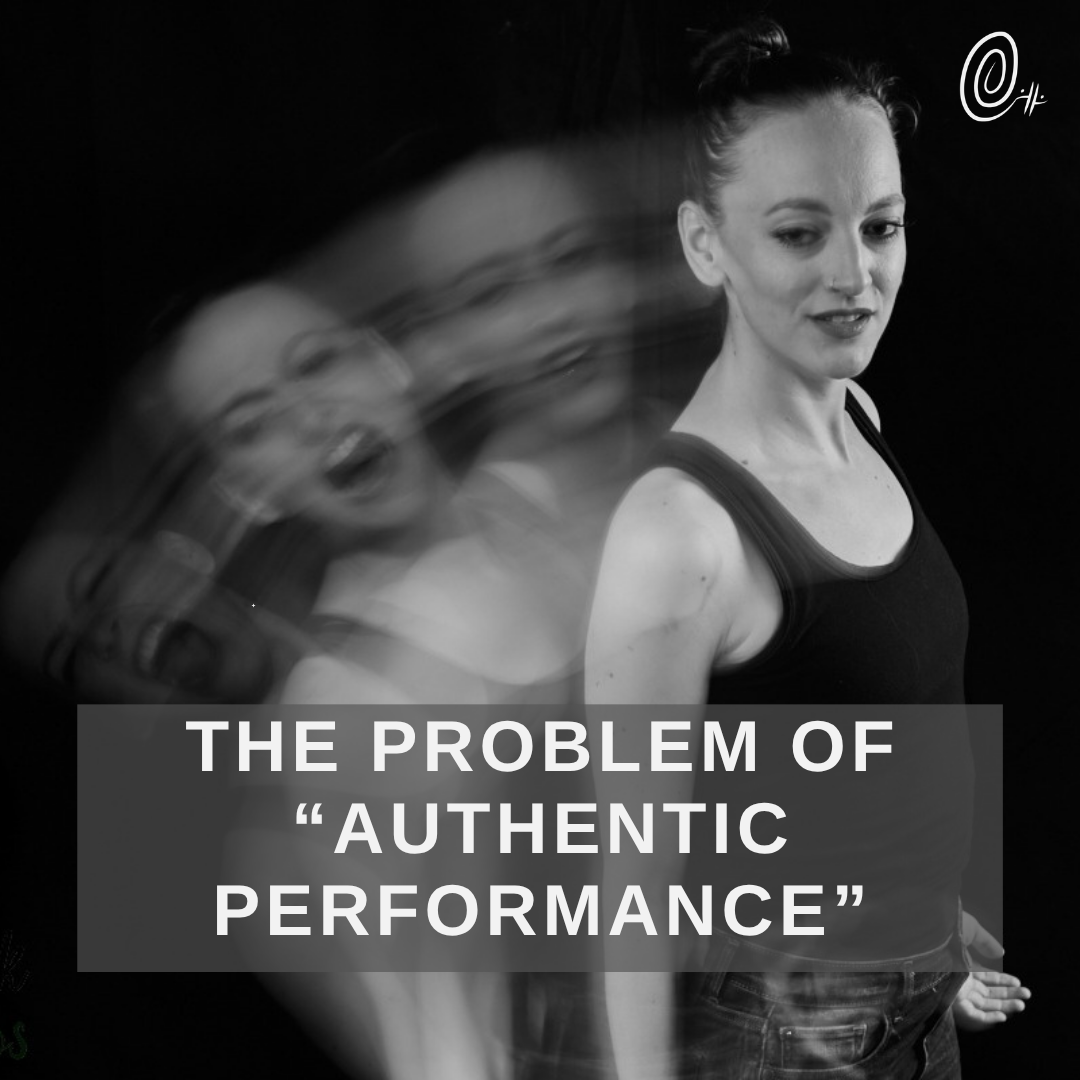
The Problem of “Authentic Performance”
Three weeks ago, I posted a reel on Instagram about the theory of “physical emotions” in my Storytelling in Motion technique, and it went more viral than I thought anything about physicality would. Nearly three weeks on, it has 20K views, 700 saves, and 200 shares. (You can watch it here.)
It got a lot of love – but also got some haters, a few people decrying the reel for advocating for “un-genuine” and inauthentic performances. In this article, I’m looking at what I said, why it’s controversial, and why I stand by it.
Physical Emotions in Storytelling in Motion
In the reel, I’m talking about how emotions happen in the body first before we identify them with words, and how the technique aims to understand what those physical effects are. It uses a system I call ‘Emotional Coding,’ which looks at how emotions change our base physicality – if they add tension or take it away, increase movement size, frequency, or speed, which direction they tend to go, if they close or open the shoulders. The idea is that if I can create a ‘code’ for each emotion (or each cocktail of emotions), then I can layer that emotion on top of any movement, gesture, or even posture.
The reel then goes on to talk about how a key part of expressing emotions in performance is to create the experience of that emotion in the audience. It asks the question if I as the performer feel the emotion, but the audience doesn’t, can we call this an effective performance? Therefore, it suggests that if I can create the experience of the emotion for the audience, it doesn’t necessarily matter if I, the performer, am truly “feeling” that emotion.
Authentic Performances and the Haters
Actors, dancers, and performing artists everywhere are constantly in search of this thing known as authentic performance. Method actors try to live what their characters might have, just to reach that authenticity. People who see themselves as very artistic look down on ‘commercial’ or ‘mainstream’ art for being inauthentic.
That’s perhaps why, when I posted this reel, a few people were very unhappy with me. Their main beef was that I was advocating for inauthentic performances, mainly because I said that a performer doesn’t have to feel the emotion in order to express it. Someone else had questioned this exact thing before in one of the drafts of my foundation documents. What they all wanted to know was, if you aren’t feeling the emotion, how can it possibly be genuine? Isn’t it all just canned and empty then, a facsimile of an emotion rather than a real feeling?
What exactly is ‘authentic’?
Before I go on, I want to just raise the issue of this idea of authentic performance. In some ways, I feel one could argue that no performance is really authentic, because performances are not real life. The point is that they aren’t. They can almost fool us but never fully do, and that’s why they are so powerful – because they are just close enough to life to speak about it, but just far enough away to give the distance needed for understanding and impact.
When we speak of authentic performance, we need to clarify what we mean: is it a recreation of the feeling or experience of the character through the performer? Is it the audience feeling that this is the case?
For me, when I think of authentic performance, it is more that the audience has a sense that they aren’t being tricked or manipulated or watching something empty, but something genuine, something that has been approached and made with care (but I’d be curious to know what you all think).
Experiencing Emotions, Not Thinking Them
So here’s the thing: for me, I feel emotions first as some kind of physical sensation, and then manage to find the right word to match it. Back in 2021 in post-Covid existential dread, I learned what anxiety was because of how it sat in my stomach and spine. When one of my best friend’s mother died, I was crying before I knew I was sad. When a long-awaited visa came through in 2022, my body exploded in relieved sobs before I could process the news.
Brene Brown’s famous book “Atlas of the Heart” details how out of touch we are with our own emotions, finding that, of the 7000 people studied over 5 years, most people manage to identify happiness, sadness, and anger. She identifies 87 emotions – not to be Captain Obvious, but that’s a LOT!
So in the reel when I say that emotions happen in the body first, that’s what I mean – they might be in response to some internal or external influence, but they are essentially a physical response that we then identify with a word that has an emotional definition.
Crying on Command and Panic Attacks on Camera
Now we come to the real question: if I, as I suggest in the reel, perform an emotion by replicating its physical effects in the body, is that authentic, or not?
Back when I was very young and living in Cambodia, I got bamboozled by some movie producer who promised I could be a big star…just, I needed to learn to cry on command. I couldn’t do it. I tried thinking of the saddest things I could. I tried to go back to childhood when you just cry (except I didn’t really but never mind). Nothing worked.
Several years later when I was playing the lead role in a telefilm in Pakistan, I had to have tears in my eyes. I used vick’s drops, and maybe got a bit close imagining myself in the scenario.
Several years after THAT, I was teaching acting in Dubai and realized that I could get very close to the ‘act’ of crying with a combination of the catching breathing, the ‘trying to breathe but also holding your breath’ that you do to not break into sobs, and the chin wobbles. And the closer I could get to the physicality of crying, the closer I got to tears.
Last year I was playing the lead role in a short film and the script called for a full out panic attack. I knew I couldn’t think my way into it, so I created the physicality of panic. In the middle of the third take, I’m not sure my body knew the difference, and it took some effort after they called “cut” to put myself back together.
A couple months ago, I was doing an acting test, and the audition script had a character that was barely holding it together. I put in all the physicality of crying, and by the middle, I was actively trying to control the tears.
The thing is, in that moment – I am not necessarily crying for the same reason as the character, but my body doesn’t really know the difference. The physicality-induced crying feels like crying. The physicality-induced panic felt like panic.
Is that genuine, or not?
Communication, Physicality, and Authenticity
At the end of the day, though, regardless of how the performer gets there or how it feels, what I’m most concerned with is a bit different, and that is communication. After all, if the performer feels the emotion, but the audience doesn’t, then what’s the point? Performances are acts of storytelling – they are meant to be watched, listened to, felt, experienced. What matters is what reaches across that gap from the performer (the storyteller) to the audience (the listener). Therefore, no matter what technique is used and who feels what, to me, a performance is successful if it leaves an impact.
The performances that I most deeply remember and cherish watching are those that pulled me apart from the inside, performances that I felt in my stomach and chest. The performances that just tickled the brain are mostly lost to memory, but those that hit on a visceral level stay with me.
My theory is that getting to that visceral level has something to do with communication and something to do with the body, and Storytelling in Motion is how I as a performer try to reach that. From my experience in creating, performing, and teaching, what I can see is that an emotion created physically – regardless of whether or not I intellectually or mentally experience that emotion – has a strong chance of being communicated.
Is that authentic?
You tell me!